



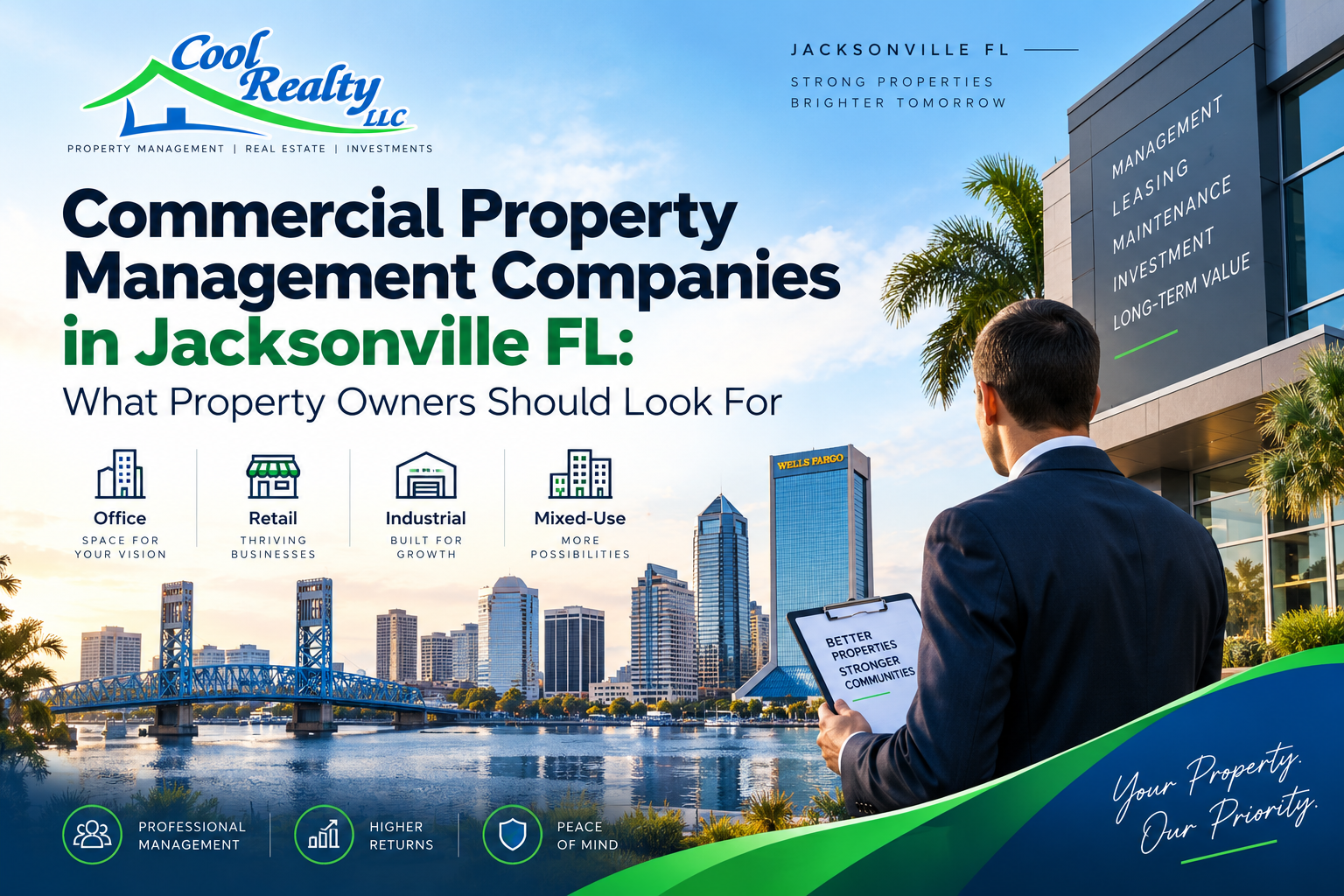
Commercial Property Management Companies in Jacksonville FL: What Property Owners Should Look For
If you own commercial property in Jacksonville an office building, a retail space, a small industrial property, or a mixed-use building deciding whether to hire a management company, and which one, is a different decision than choosing residential property management. The service categories overlap on paper, but what actually matters day to day is different enough that it's worth understanding before you start comparing companies.
This guide covers what commercial property management actually involves, how it differs from residential management, what it typically costs, and a practical framework for evaluating providers in the Jacksonville market not a ranked list of companies, but a way to think through the decision yourself.
What Does a Commercial Property Management Company Do?
A commercial property management company handles the day-to-day operational and financial responsibilities of a commercial property on behalf of its owner, including tenant placement and leasing support, rent collection, maintenance and vendor coordination, financial reporting, compliance, and tenant retention.
In practice, that spans two broad categories of work. The first is operational: keeping the property maintained, coordinating vendors, handling tenant requests, and making sure the building runs. The second is financial and strategic: tracking income and expenses, reporting to the owner, and for firms that offer it advising on how to protect or grow the property's value over time. A commercial manager is generally expected to think about the property as a financial asset, not just a physical space that needs upkeep.
Core Commercial Property Management Services
The specific service mix varies by company, but most commercial property management providers offer some combination of the following:
Asset management → monitoring market conditions and property performance with an eye toward net operating income, not just occupancy.
Tenant placement and leasing support → marketing vacant space, coordinating showings, and managing lease negotiations or renewals.
Rent collection → collecting rent and, where applicable, common area maintenance charges or other pass-through costs.
Maintenance and vendor coordination → managing repair requests, typically through a work-order system, and coordinating outside vendors for larger jobs.
Compliance → helping ensure the property meets relevant building, safety, and lease-related obligations.
Financial reporting → regular statements covering income, expenses, and budget performance, usually monthly.
Tenant retention → proactive communication and service aimed at keeping good tenants in place, since commercial vacancy is typically more costly and slower to fill than residential vacancy.
Owner and tenant portals → online systems for real-time access to financial information, work orders, and communication.
On-call or emergency support → a point of contact for issues that come up outside normal business hours.
Not every commercial management company offers every service on this list, and the right combination depends on your specific property. This is one of the most important things to clarify before signing an agreement, not after.
Types of Commercial Properties Property Managers Handle
Commercial property management typically covers several distinct property types, each with different operational demands:
Office → from single-tenant buildings to multi-tenant office parks, often involving common area maintenance and shared-space considerations.
Retail → storefronts, strip centers, and shopping centers, where foot traffic, visibility, and tenant mix matter alongside standard maintenance.
Industrial → warehouses, distribution centers, and light manufacturing space, which often have different maintenance and compliance needs than office or retail.
Mixed-use → properties combining two or more of the above, which can require coordinating different tenant types and lease structures under one roof.
Not every management company handles every property type equally well some specialize in one category, while others manage a broader mix. It's worth asking directly about a company's specific experience with your property type rather than assuming general commercial experience translates evenly across office, retail, and industrial space.
Commercial vs. Residential Property Management
Commercial and residential property management share some surface-level similarities both involve tenants, rent collection, and maintenance but the underlying work is different enough that experience in one doesn't automatically translate to the other.
Commercial leases are typically longer, more heavily negotiated, and more varied in structure (some pass property expenses through to tenants; residential leases generally don't). Commercial tenants are businesses, not individuals, which changes how screening, communication, and lease enforcement work. Commercial vacancies tend to take longer to fill and cost more per month when they happen, which puts more weight on tenant retention and proactive lease management. And commercial properties are usually evaluated more explicitly as income-producing financial assets reporting and asset-management thinking tend to be more central to the service than in residential management, where the focus is more operational.
None of this means one is harder than the other they're simply different disciplines, and it's reasonable to ask a prospective manager directly about their specific commercial experience rather than assume residential success carries over.
How to Evaluate Commercial Property Management Companies in Jacksonville FL
Rather than looking for the "best" company a claim that's hard to verify and easy to overstate it's more useful to evaluate providers against a consistent set of criteria:
Local market knowledge. Does the company understand Jacksonville's commercial submarkets specifically, or is their knowledge generic to Florida or the Southeast broadly?
Maintenance and vendor coordination. How are maintenance requests submitted and tracked? Is there an established vendor network, and how is emergency or after-hours coverage handled?
Tenant and leasing support. How does the company market vacant space and screen prospective commercial tenants? What's their approach to lease negotiation and renewal?
Financial reporting. How often are reports provided, and how detailed are they? Ask to see a sample report before signing anything.
Communication. How will you be updated, and how quickly can you expect a response to a question or concern?
Technology and owner portal. Is there a real-time system for reviewing financials, work orders, and communication, or does getting an update require a phone call?
Compliance. How does the company handle building code, safety, and lease-compliance obligations specific to commercial property?
Emergency response. What's the actual process not just the marketing claim for after-hours or urgent issues?
Scope of services. Does the proposed service list match what your specific property actually needs, or does it feel like a generic package?
Management agreement and fees. What exactly is included in the base fee, what's billed separately, and what are the terms for ending the agreement?
Questions to Ask Before Hiring a Commercial Property Manager
What specific experience do you have with my property type (office, retail, industrial, or mixed-use)?
What's included in your management fee, and what's billed separately?
How do you handle tenant placement and lease negotiation for vacant space?
What does your maintenance and vendor coordination process actually look like?
How often will I receive financial reports, and what do they include?
What's your actual process for emergency or after-hours issues?
How do you approach tenant retention specifically?
What are the terms for ending the management agreement if it's not working out?
What Does Commercial Property Management Cost?
Commercial property management fees vary significantly depending on property type, size, location, tenant mix, and the specific scope of services included there isn't a single standard rate that applies across every property.
Industry sources generally describe commercial management fees as falling somewhere between roughly 2% and 12% of collected monthly rent, with many properties landing in a 4–10% range, though smaller or more management-intensive properties can run higher. Some companies use a flat monthly fee instead of a percentage, and separate fees often apply for tenant placement or lease renewals (commonly a percentage of the lease value) and for coordinating larger maintenance or repair work. The right way to evaluate cost isn't the headline percentage alone it's that percentage together with what's actually included, and what gets billed as an add-on.
Cool Realty LLC does not publish a standardized commercial management fee, since commercial pricing depends heavily on the specifics of each property; a fee is typically structured after understanding what a given property actually needs.
Commercial Property Management in Jacksonville and Northeast Florida
Jacksonville's commercial real estate market spans a wide geographic footprint from downtown office space to retail and industrial properties throughout Duval, Clay, St. Johns, and Nassau counties and the right management approach for a small retail storefront looks different from what an industrial warehouse or a multi-tenant office building needs. A manager with genuine local familiarity should be able to speak specifically to how your property type and location affect leasing demand, maintenance considerations, and realistic vacancy expectations, rather than offering the same general answer regardless of where in the region your property sits.
Looking for Commercial Property Management in Jacksonville?
Cool Realty LLC provides commercial property management services to Jacksonville-area owners and investors, including property maintenance and compliance, tenant placement, rent collection, accounting and reporting, on-call property managers, and web-based portals for owners and tenants. Learn more about our commercial property management services, or request a free property consultation to talk through what your specific property needs.
Frequently Asked Questions
What does a commercial property management company do?
It handles the operational and financial management of a commercial property on an owner's behalf tenant placement, rent collection, maintenance coordination, financial reporting, and compliance so the owner isn't managing those tasks directly.
Do commercial property managers handle maintenance?
Yes, typically through a work-order system that tracks requests and coordinates vendors, though the specific process varies by company.
Do commercial property managers handle leasing?
Most do, including marketing vacant space and supporting lease negotiations or renewals, though the specific scope of leasing support varies by provider and agreement.
How much does commercial property management cost in Jacksonville FL?
It varies by property type, size, and services included. General industry sources put typical commercial management fees somewhere between about 2% and 12% of collected rent, with separate fees often applying for tenant placement and larger maintenance work. There's no single standard rate, and providers in the Jacksonville market don't uniformly publish a fixed percentage.
Is hiring a commercial property manager worth it?
For many owners, yes particularly those who don't have the time, local market knowledge, or vendor relationships to manage tenant placement, maintenance, and compliance directly. Whether it's worth the cost for a specific property depends on the property's size, complexity, and how much of that work an owner could realistically handle alone.
What's the difference between commercial and residential property management?
Commercial management deals with business tenants, longer and more varied lease structures, and a stronger emphasis on the property as a financial asset. Residential management is generally more operationally focused, with individual tenants and more standardized leases.
What types of commercial properties do property managers manage?
Common categories include office, retail, industrial, and mixed-use properties, though not every management company has equal experience across all four.